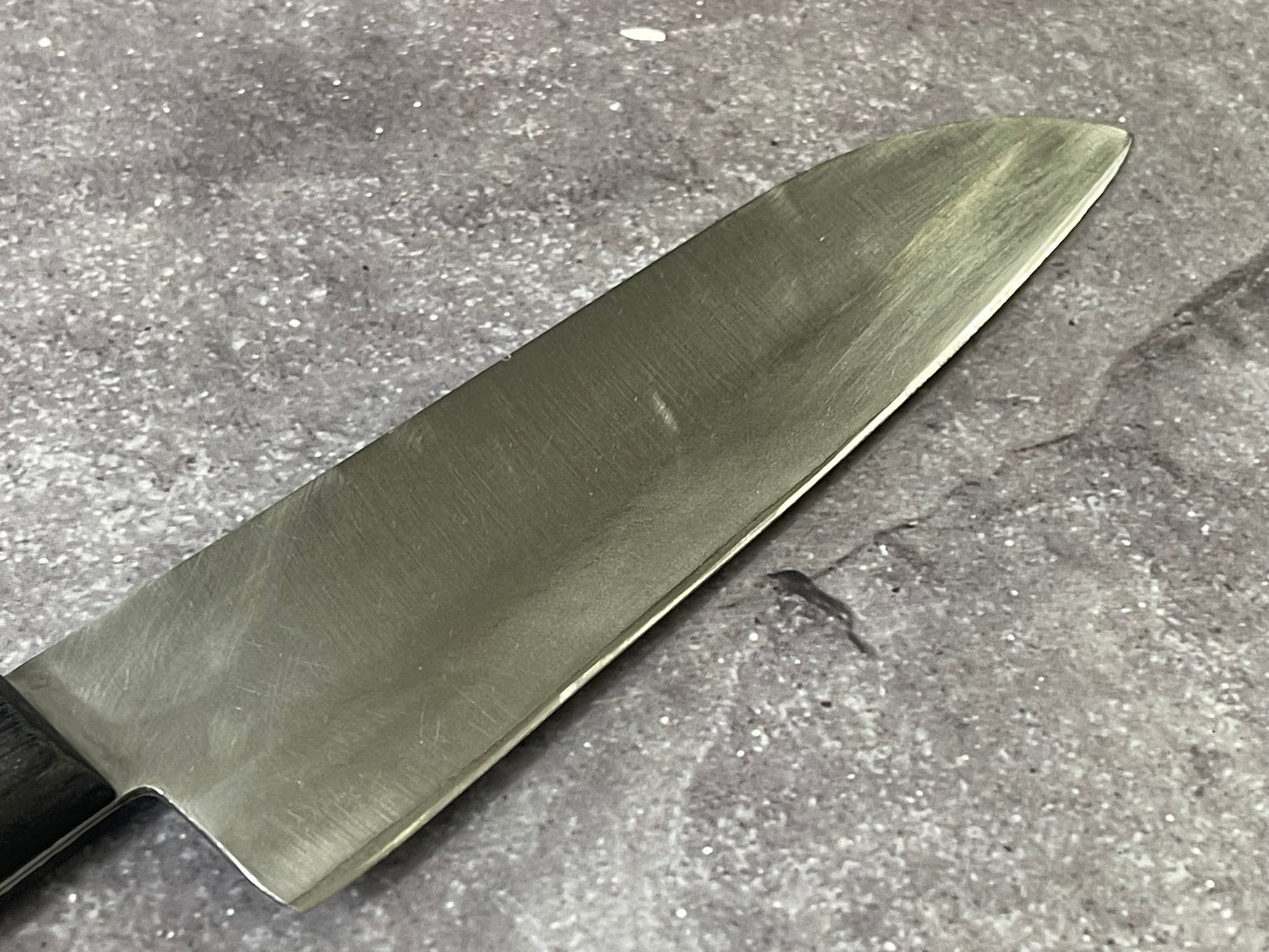
Experience Compact Japanese Preparation with a Vintage Masazumi Santoku
This pre-owned Masazumi Santoku combines a compact 160mm blade with a wood handle. Recorded as carbon steel, fully forged and made in Japan, it offers a nimble everyday preparation format for smaller cutting boards.
The Specs
Recorded maker / brand: Masazumi
Recorded markings: 正澄, 本割込 and DP処理
Knife type: Santoku
Blade length: 160mm
Overall length: 290mm
Recorded blade thickness: 1.4mm
Steel: High carbon steel in the original specifications; exact alloy not confirmed
Recorded construction: Fully forged; Hon-Warikomi laminate construction noted
Recorded hardness: 58 HRC
Handle: Wood
Origin: Made in Japan
Condition: Used / pre-owned
Masazumi and the Recorded Blade Markings
The original inscription notes read 正澄 as Masazumi and 本割込 as Hon-Warikomi. Those notes describe a three-layer laminate with a hard steel core between protective outer layers, identifying the outer layers as stainless steel. The exact core alloy and cladding composition are not independently established by these recorded readings.
The notes also record DP処理, translated as DP processed, and associate it with processing intended to limit decarburisation during manufacture. The marking is retained without using it to guarantee a particular alloy, heat treatment or level of sharpness. No production date or additional maker history is assigned.
The Santoku, commonly translated as three virtues, is an all-purpose format for meat, fish and vegetables. Its flat-to-gently-curved edge suits push cuts and light rocking, while the wide blade offers knuckle clearance. This 160mm example provides a compact option for everyday preparation. Care for it as carbon steel in line with the original specifications.
Care & Maintenance
Hand wash only, never in the dishwasher
Dry immediately after washing to help prevent rust
Do not soak the wood handle
Natural patina may develop on exposed carbon steel; remove active rust rather than treating it as patina
Sharpen on a whetstone, preserving the existing edge geometry
Store on a magnetic strip or in a knife block to protect the edge
Age restriction: The purchase of knives is restricted to persons aged 18 years and over in accordance with applicable Australian state and territory laws, including the Queensland Weapons Act 1990 and South Australian Summary Offences Act 1953. By purchasing a knife through this store, you confirm you are aged 18 or over.
Choosing a selection results in a full page refresh.